(Re)Connecting Communities, January ‘26 Updates
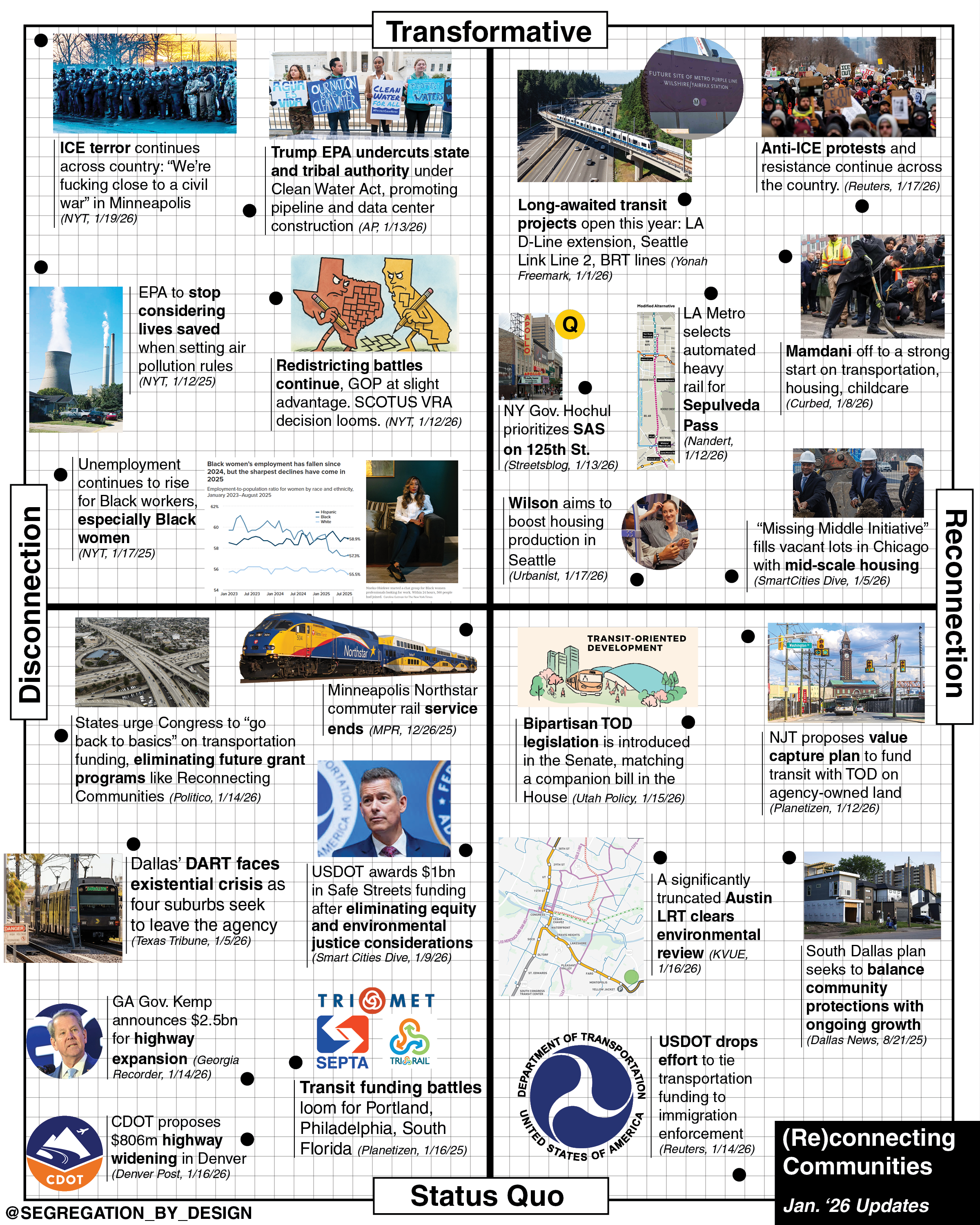
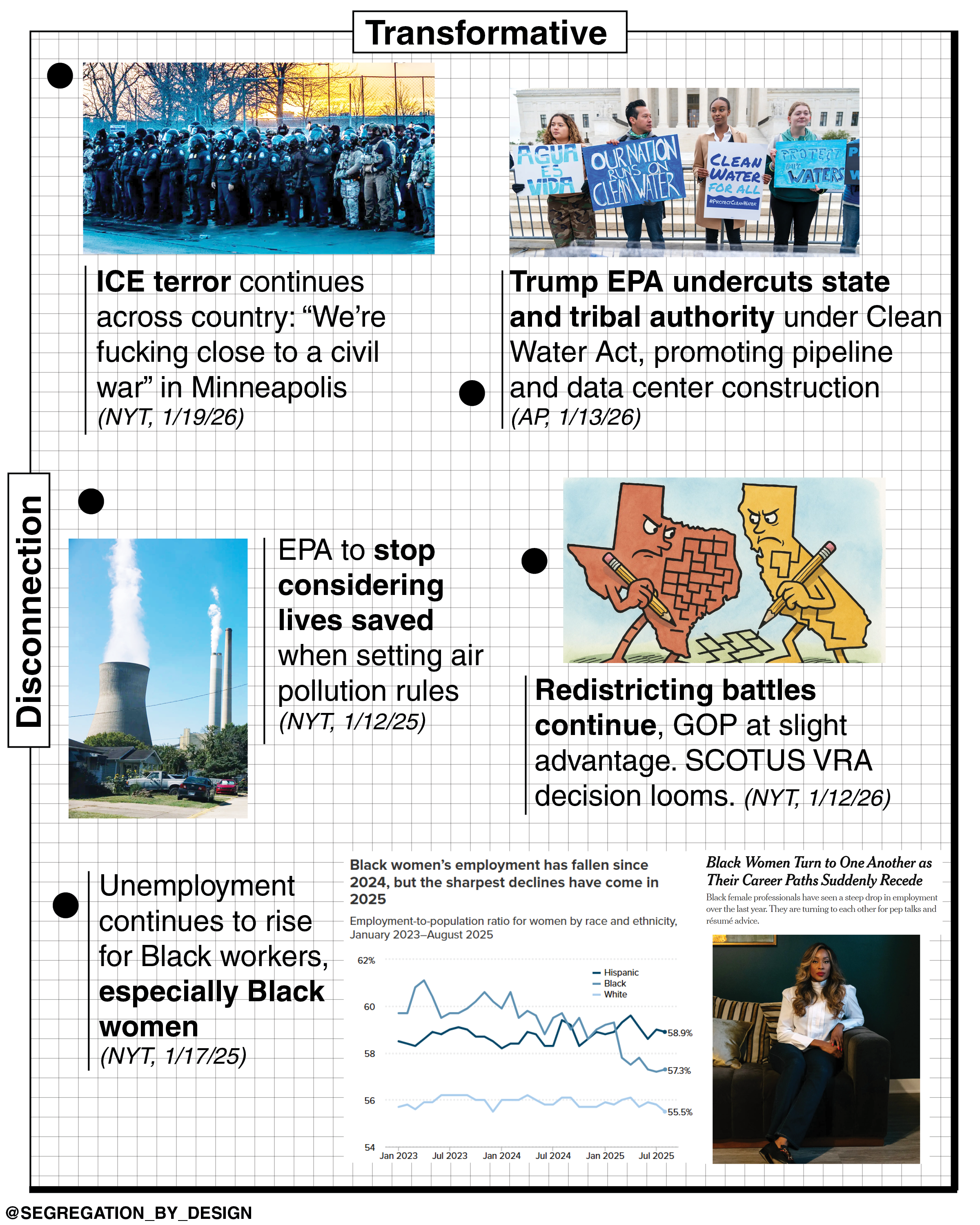
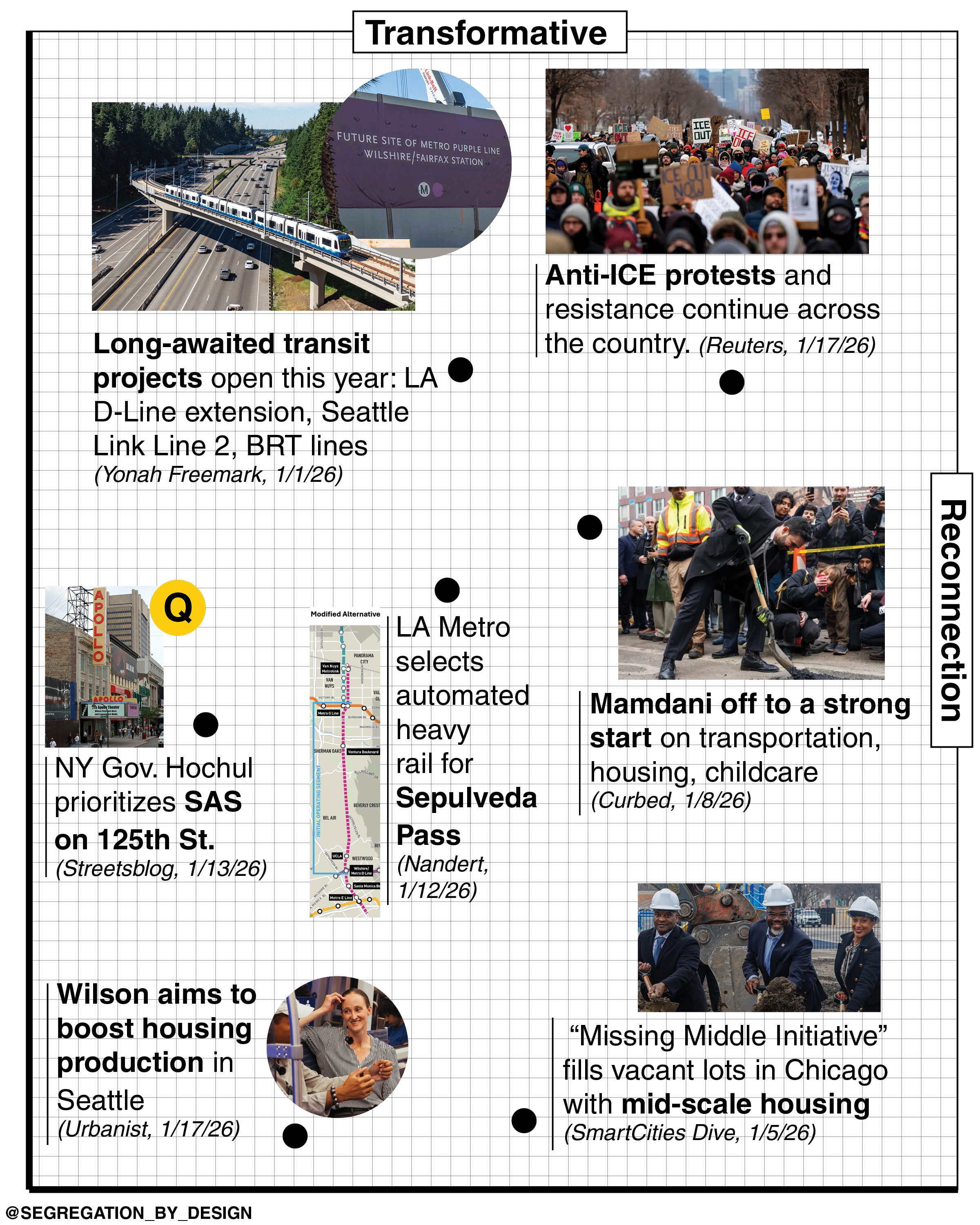
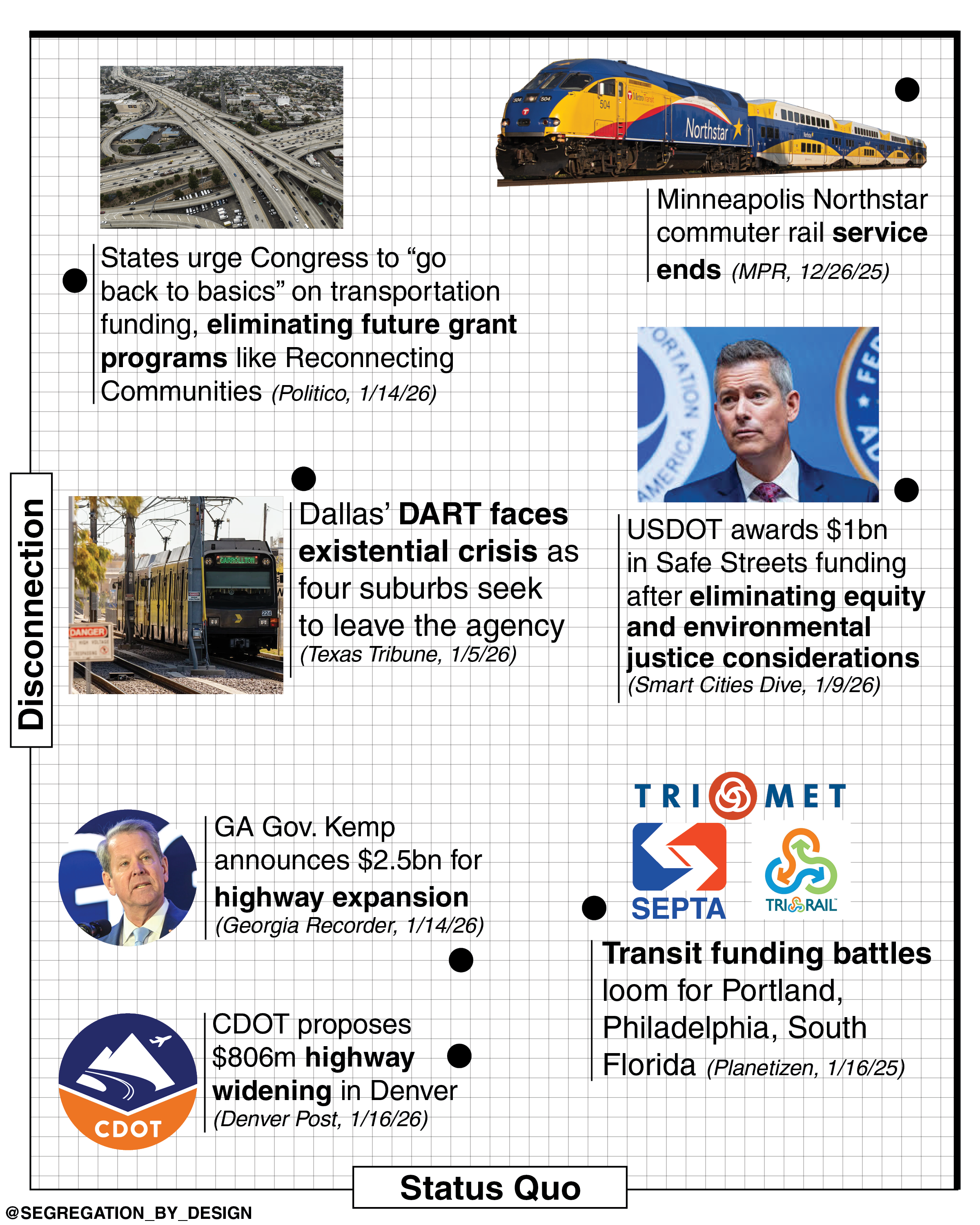
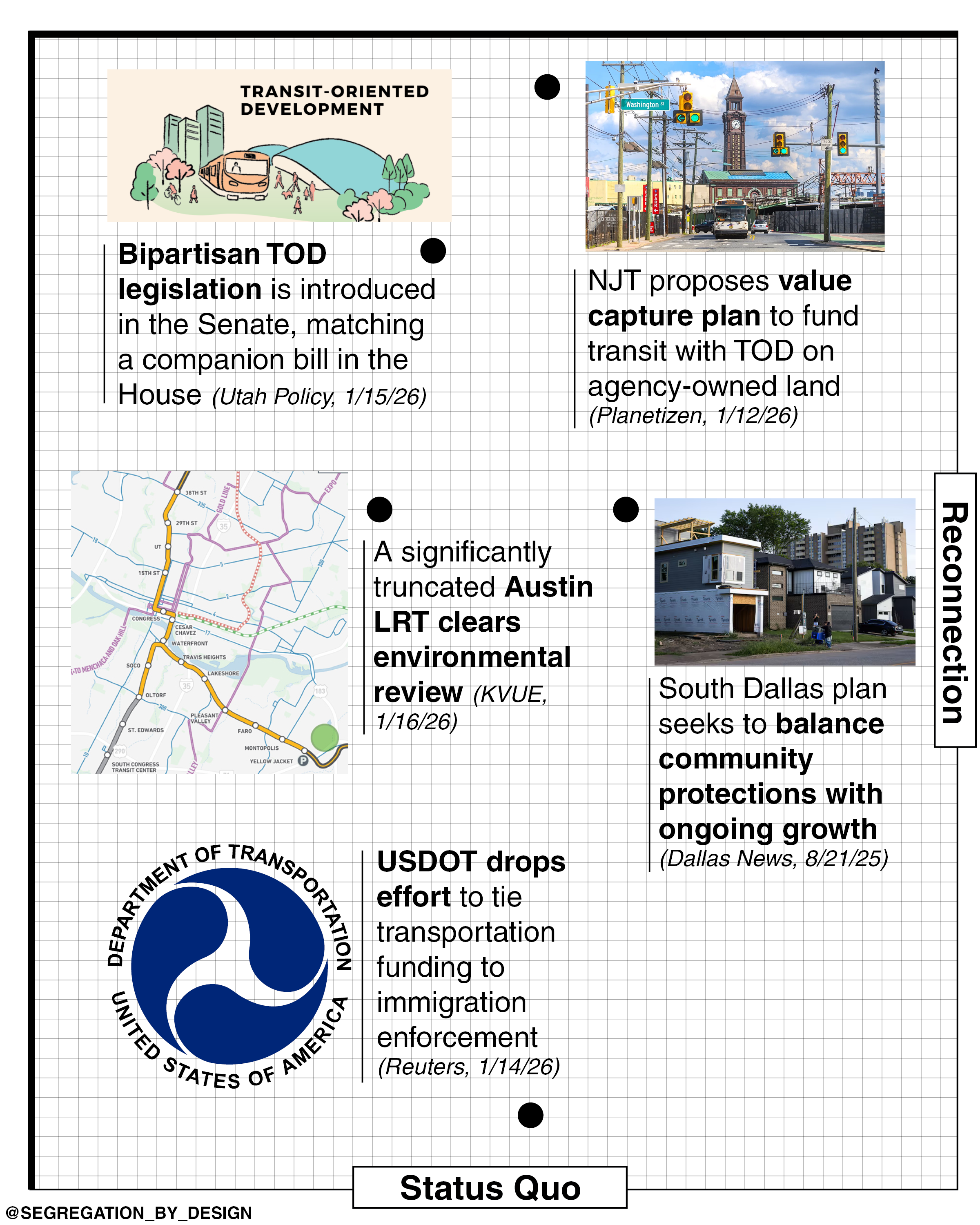
(Zoomed versions of each quadrant available below.)
January update of “Reconnecting Communities” news, which focuses on developments relating to overcoming discriminatory urbanism.
This month shows us that, even as the federal government convulses between fits of international imperialism and domestic authoritarianism (while stealing our tax dollars in the process), there’s still a lot of good work happening at the state, local, and grassroots level. Just see the upper-right quadrant of the chart: anti-ICE resistance across the country shows us in real time that communities can quickly organize far more good people than the government can hire random goons. Decades of advocacy and public investment in transit will continue to pay off, as new subway, LRT, and bus lines open around the country, transformative steps toward creating a more equitable mobility system. Progressive new local administrations—notably in NYC and Seattle—have “hit the ground running,” with proposals directly attacking the high cost of living that continues to exacerbate existing patterns of class and racial segregation. In short: the federal situation is basically as bad as it could be (though, for now, at least the bond market seems safe. Phew.), but there’s too much hard-work, organizing, and advocacy going on out there to be entirely pessimistic.
Back to the chart: Like last time, developments are arrayed along two axes: one axis which positions an item based on whether it represents progress towards reconnection, or the opposite; and another axis which (for better or worse) compares whether an item represents transformative change vs. something more ingrained in the status quo.
On the “Reconnecting” side are developments which are progress away from the legacy of “Segregation by Design.” These include projects which advance spatial justice, such as large-scale infrastructure redesigns for more equitable mobility/land-use/housing, legal victories for affected communities, reparative actions, etc. On the other hand, “Disconnection” is defined as items that are further retrenchment of exclusionary urban design and environmental racism.
Items on the “Transformative” half are developments that move away from present systems and procedures, potentially resulting in fundamental shifts to existing institutions and practices (again, for better or worse). This includes news involving novel legal arguments, funding mechanisms, infrastructure and design approaches, etc., or which indicate structural/long-term shifts to present institutions. On the other hand, “Status Quo” developments involve making use of established processes and represent less radical departures from existing systems (or, are potentially transformative projects which are still early in the development phase, and whose potential impact is difficult to determine).
Links
Transformative Disconnection
ICE terror continues across country: “We’re fucking close to a civil war” in Minneapolis. (NYT, 1/19/26)
Unemployment continues to rise for Black workers, especially Black women. (NYT, 1/17/26)
Trump EPA undercuts state and tribal authority under Clean Water Act, promoting pipeline and data center construction. (AP, 1/13/26)
EPA to stop considering lives saved when setting air pollution rules. (NYT, 1/12/26)
Redistricting battles continue, GOP at slight advantage. SCOTUS VRA decision looms. (NYT, 1/12/26)
Transformative Reconnection
Anti-ICE protests and resistance continue across the country. (Reuters, 1/18/26)
Wilson aims to boost housing production in Seattle. (The Urbanist, 1/17/26)
“Missing Middle Initiative” fills vacant lots in Chicago with mid-scale housing. (Smart Cities Dive, 1/15/26)
NY Gov. Hochul prioritizes SAS on 125th St. (Streetsblog NYC, 1/13/26)
LA Metro selects automated heavy rail for Sepulveda Pass. (Nandert, 1/12/26)
Mamdani off to a strong start on transportation, housing. (Curbed 1/8/26)
Long-awaited transit projects open this year: LA D-Line extension, Seattle Link Line 2, BRT lines. (Yonah Freemark, 1/1/26)
Status Quo Disconnection
CDOT proposes $806m highway widening in Denver. (Denver Post, 1/16/25)
States urge Congress to “go back to basics” on transportation funding, potentially eliminating future grant programs like Reconnecting Communities. (Politico, 1/14/26)
GA Gov. Kemp announces $2.5bn for highway expansion. (Georgia Recorder, 1/14/26)
USDOT awards $1bn in Safe Streets funding after eliminating equity and environmental justice considerations. (Planetizen, 1/9/26)
Dallas’ DART faces existential crisis as four suburbs seek to leave the agency. (Texas Tribune, 1/5/26)
Minneapolis Northstar commuter rail service ends. (MPR, 12/26/25)
Transit funding battles loom for Portland (more info), Philadelphia (more info), South Florida (more info).
Status Quo Reconnection
A significantly truncated Austin LRT clears environmental review. (KVUE, 1/16/26)
Bipartisan TOD legislation is introduced in the Senate, matching a companion bill in the House. (Utah Policy, 1/15/26)
NJT proposes value capture plan to fund transit with TOD on agency-owned land. (Planetizen, 1/12/26)
USDOT drops effort to tie transportation funding to immigration enforcement. (Reuters, 1/12/26)
South Dallas plan seeks to balance community protections with ongoing growth. (Dallas News, 8/21/25)