(Re)Connecting Communities, April ‘26 Updates
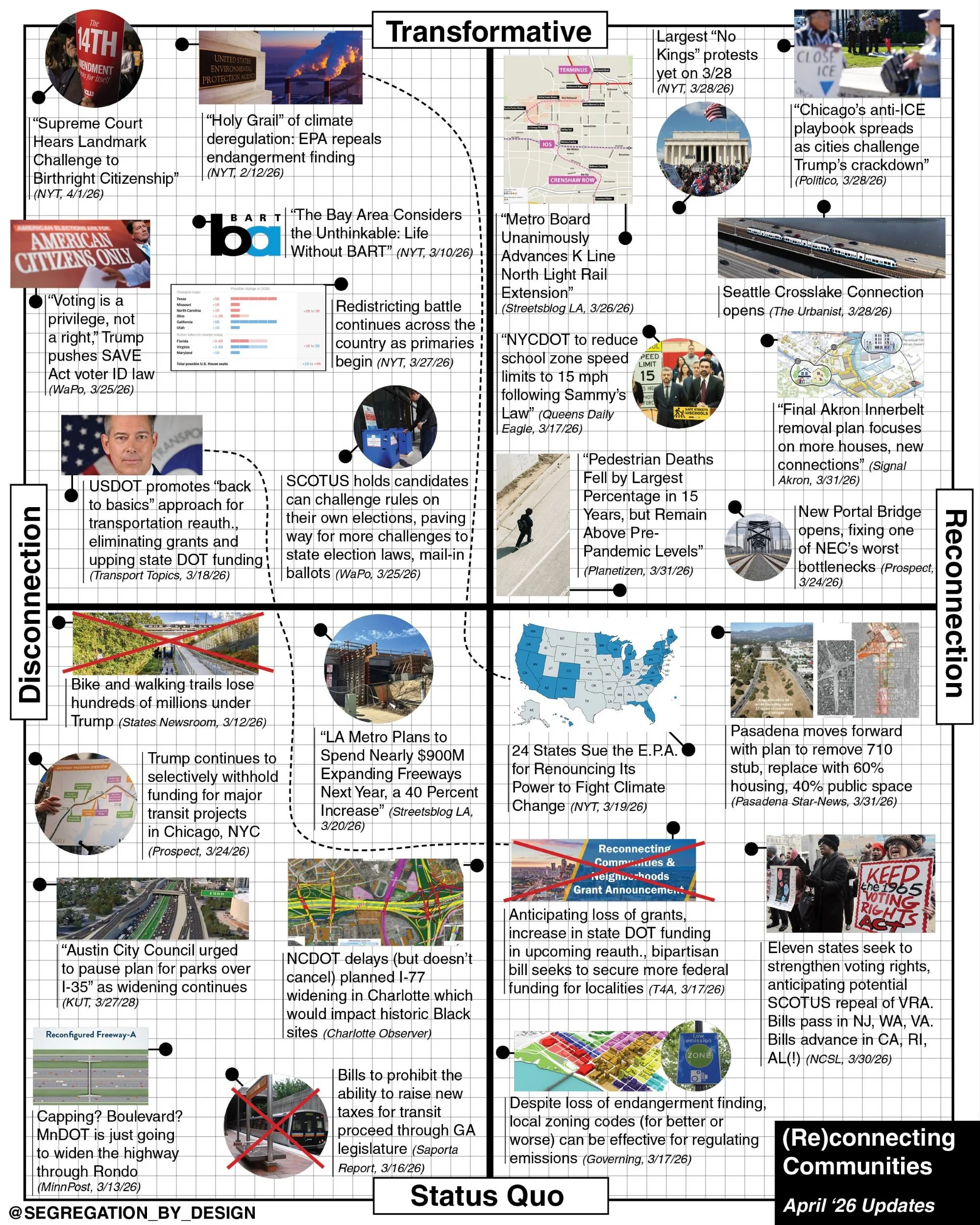
(Zoomed versions of each quadrant and links to individual articles available below.)
April update of “Reconnecting Communities” news, which focuses on developments relating to overcoming discriminatory urbanism.
One of the advantages of looking comparatively across cities in this fashion is identifying trends across local and state developments, especially concerning the many ongoing highway redesigns, retrofits, and expansions (in addition to policy developments, like the ongoing trend of states seeking to bolster their own voting rights legislation in anticipation of SCOTUS striking down what remains of the Voting Rights Act).
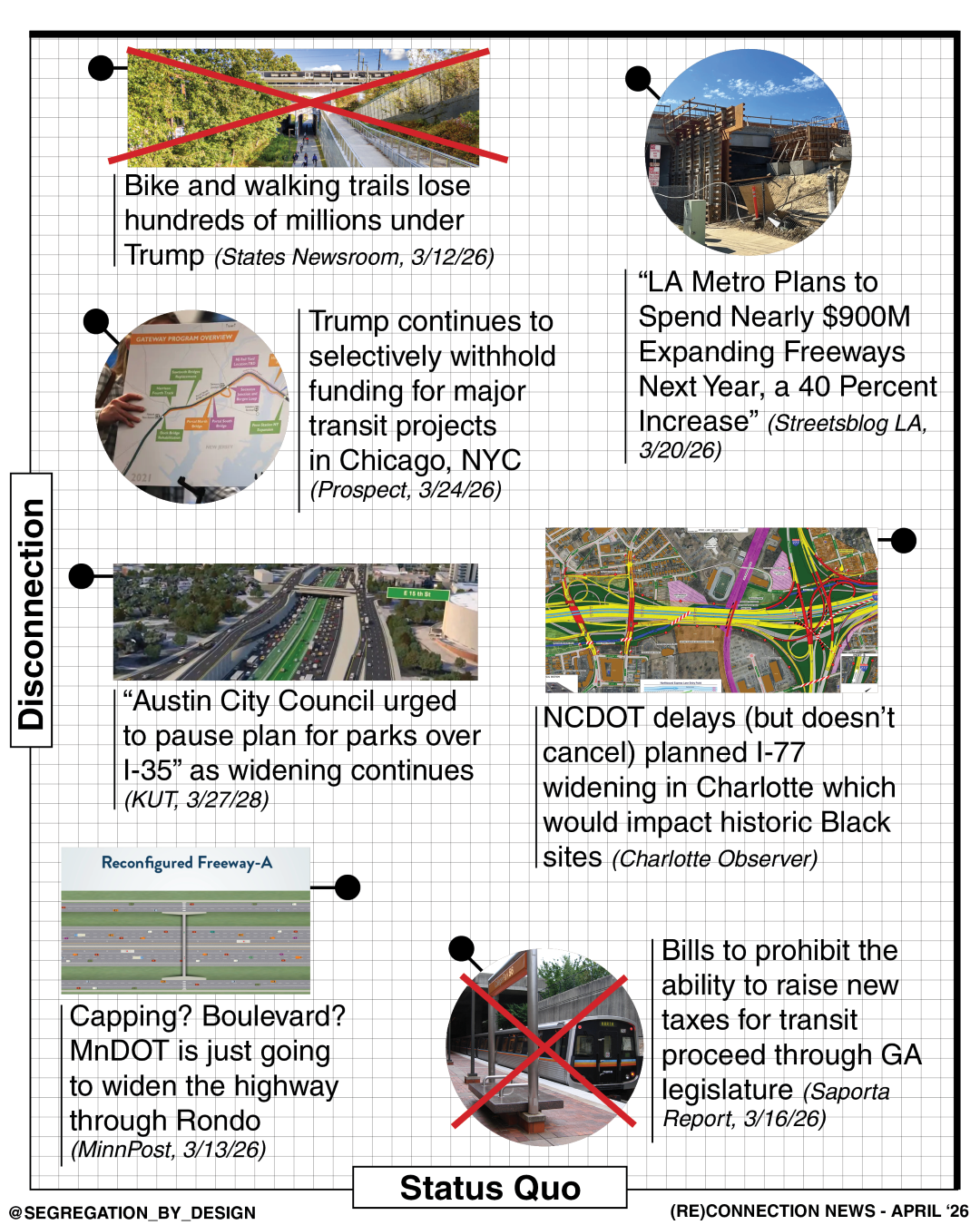
One unfortunate trend is reflected in recent developments in Austin’s “I-35 CapEx” project and Minneapolis’ “Rethinking 94.” Both of these projects were supposed to result in caps being built over highways which had a history of dividing and displacing Black communities. Instead, both of these projects will simply be further widenings of the existing highways—with the decision to build caps deferred to a future date.
I say this is a “trend” as these projects are yet more instances of the promise of caps being used to justify widening the highways beneath them—sometimes significantly so. One could argue this started with the Big Dig itself, an oft-cited inspiration for many of these projects, which replaced a six lane elevated structure with a 10 lane tunnel. More recently, capping projects in Dallas (Oak Cliff) and Denver—both of which prominently centered equity—have nearly doubled the width of the highways beneath.
While most of these projects have certainly resulted in improved urban placemaking and a limited degree of physical “reconnection” within the vicinity of the caps themselves, they have done little to reduce air pollution in surrounding areas, and have done even less to promote the sort of large-scale mode shift to more equitable mobility that advocates had hoped such projects could begin to achieve. In Denver, recordings of pollution (PM2.5) at the edges of the caps are at concentrations higher than uncapped areas, “because the park blocks air pollution dispersion, allowing it to build up to higher concentrations before wafting out of the tunnel openings,” writes Colorado Public Radio. Moreover, the park has “triggered gentrification fears” due to rising housing costs nearby the park.
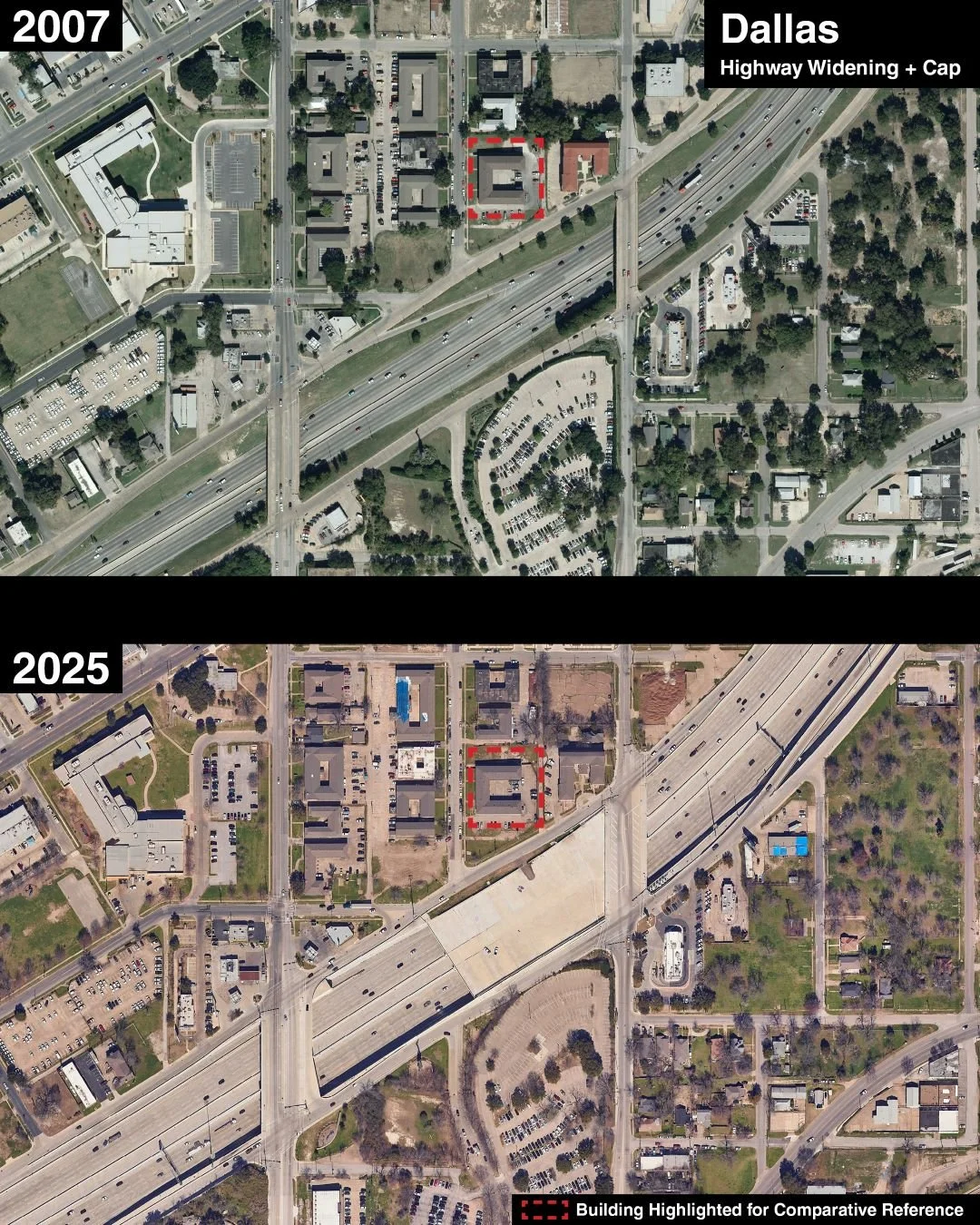
Oak Cliff, Dallas, 2007 vs. 2025
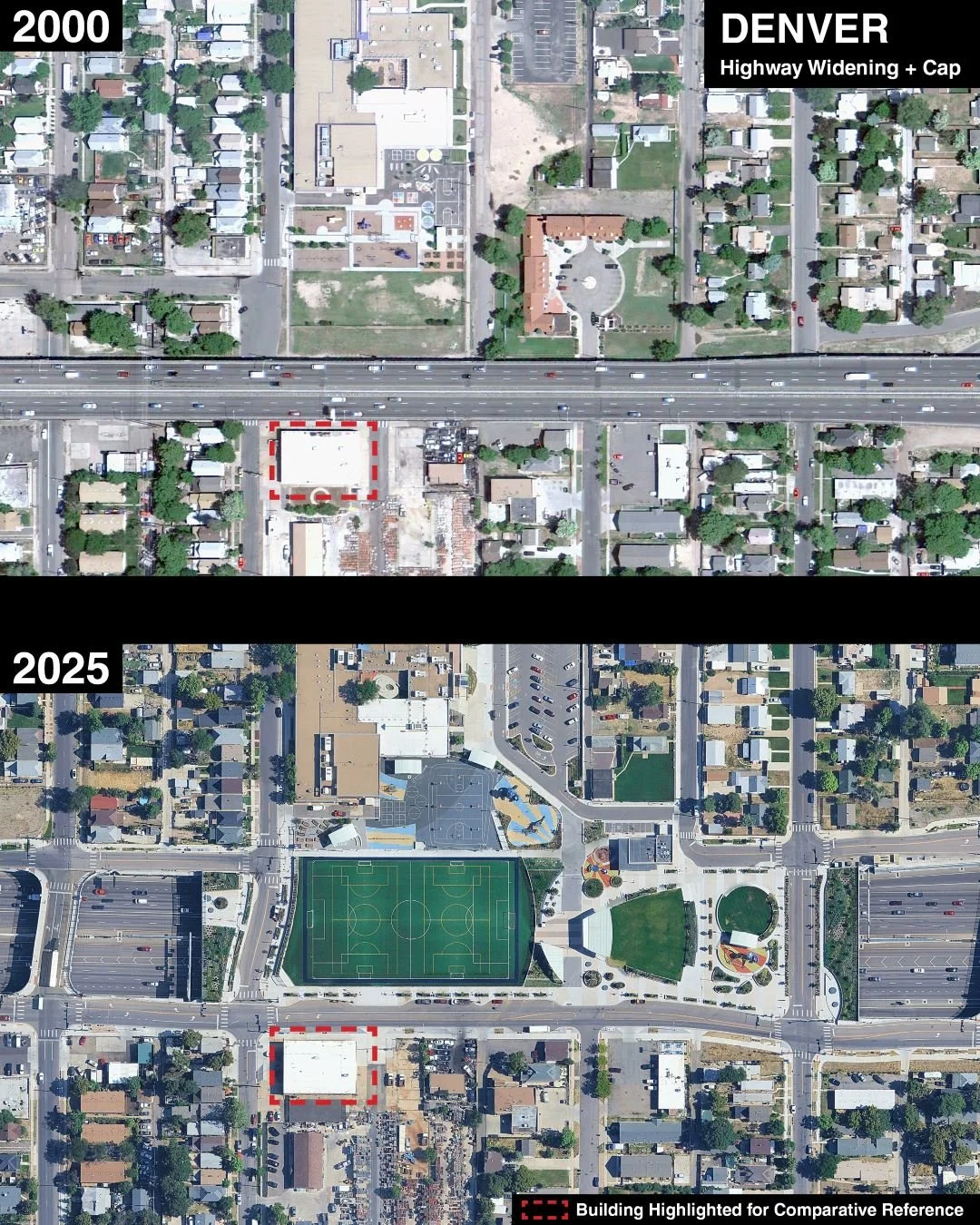
Elyria-Swansea, Denver, 2000 vs. 2025
This is not to say a cap is not worth pursuing in all cases. For some highways, like the Cross Bronx Expressway, it is probably the only realistic option in today’s political environment (and we can hope that someday, perhaps, we can solve the problem of regional freight and use the ROW for something better than a highway). And either way, caps can be better designed than Colorado’s, which was the “worst configuration” possible from an air quality perspective, according to Suzanne Paulson, atmospheric scientist at UCLA (unfortunately Austin’s and Oak Cliff’s are basically the same). With mechanical ventilation, such as what is used on the Big Dig, the pollution can be released more diffusely, and the ventilation structures themselves can become pieces of civic art/placemaking, such as the “chimneys” of Paris’ La Defense.
In any event, it looks like both Austin and Minneapolis will not be getting caps anytime soon, well-designed or not. Instead they will just have widened highways. What is also concerning is that both of these cap projects received money from the “Reconnecting Communities Pilot” (RCP). In both cases, the State DOT leading the project subsequently used the promise of caps to mitigate local criticism of the widening (prominently featuring the caps in promotional materials), while leaving the actual financing of the caps up to the municipalities. Given inflated construction costs and the rescission of the Reconnecting Communities grants, it is less and less likely that the cap component of these projects will ever actually be built (while the widening components are fully funded).
In the end, while the RCP undoubtedly struck the right tone and led to many successes, in the cases of Minneapolis and Austin (and potentially Portland), the program intended to reconnect communities instead funded highway widenings. Worse yet: it funded the PR for highway widenings, allowing these status-quo projects to cloak themselves in the mantle of “justice.”
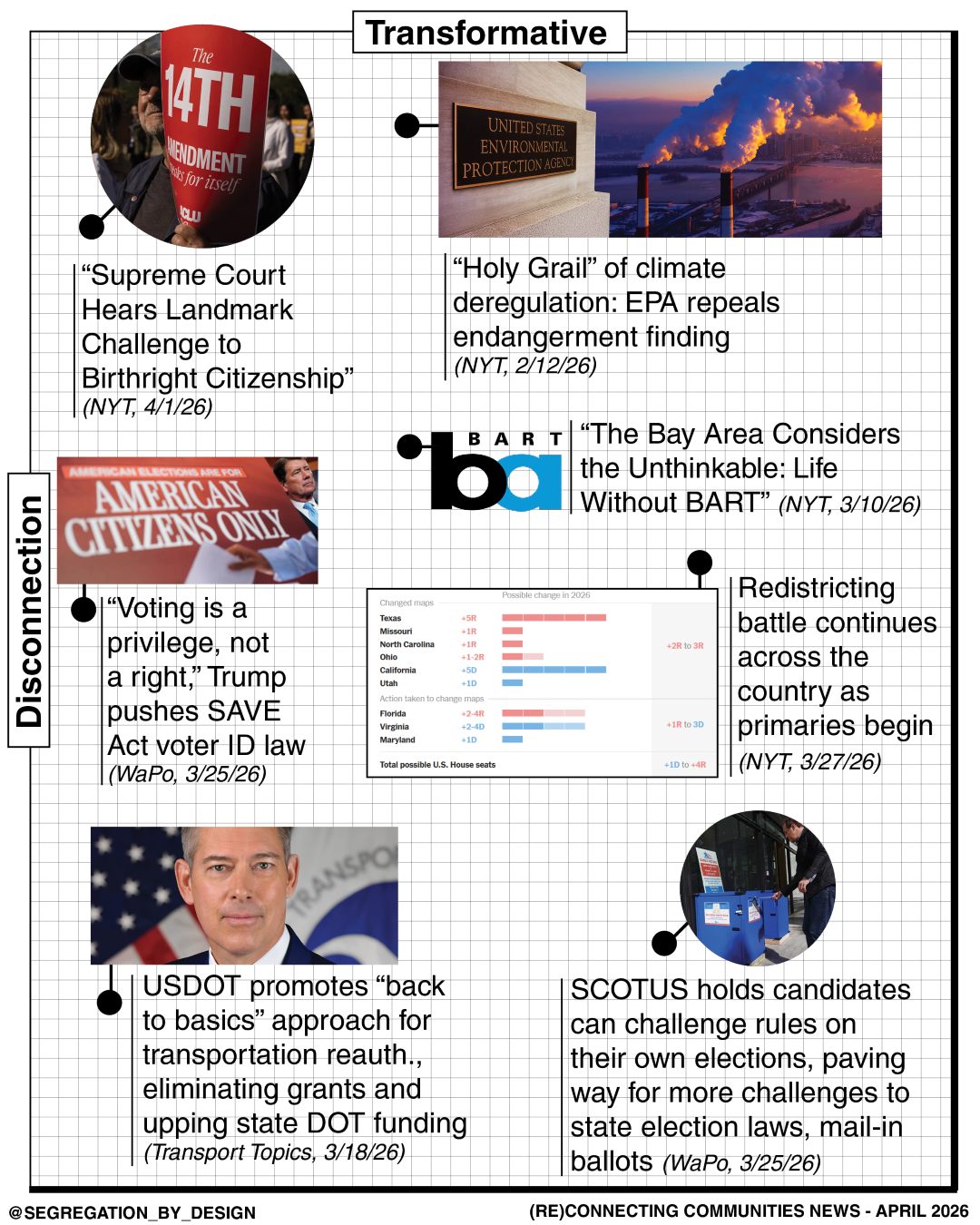
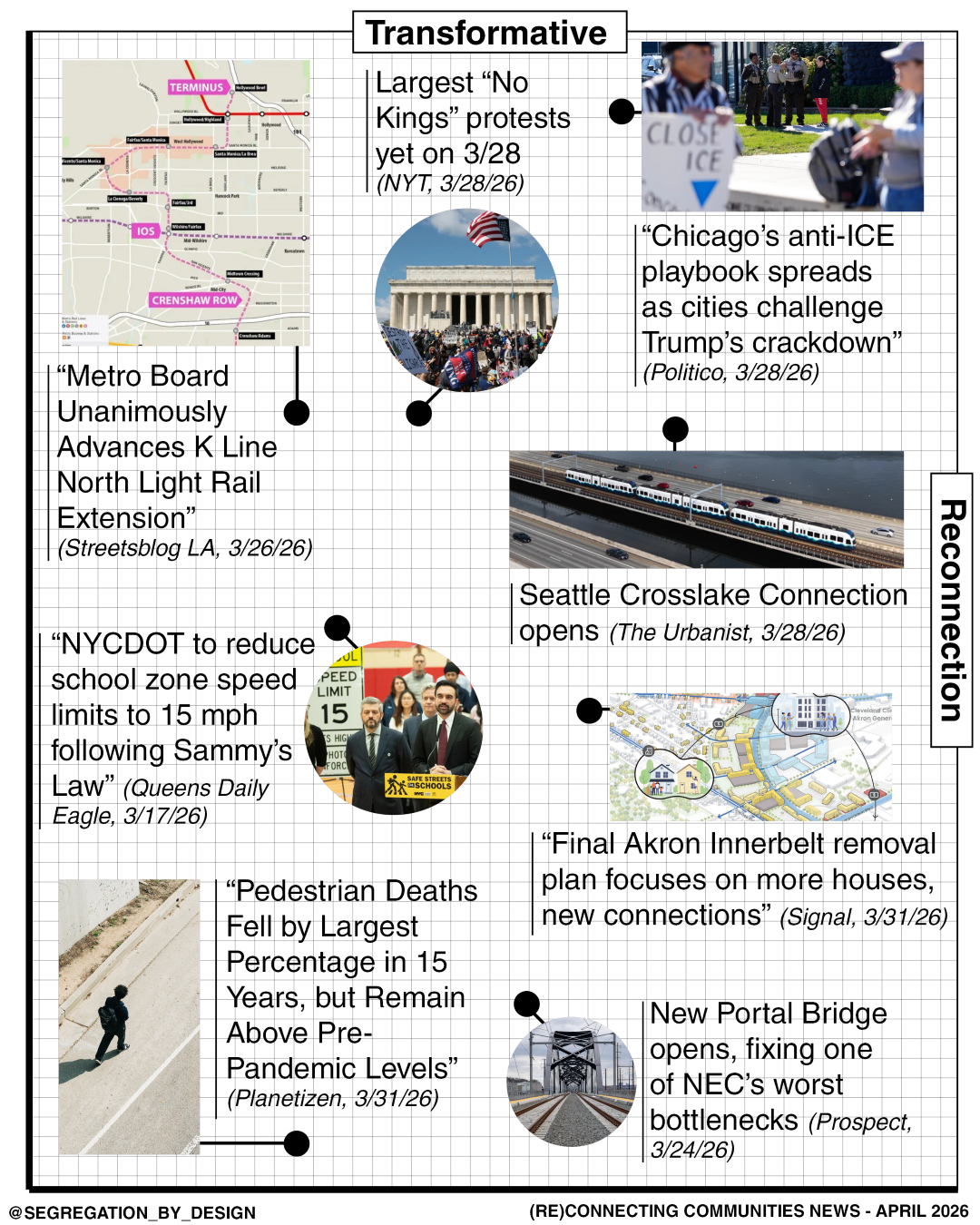
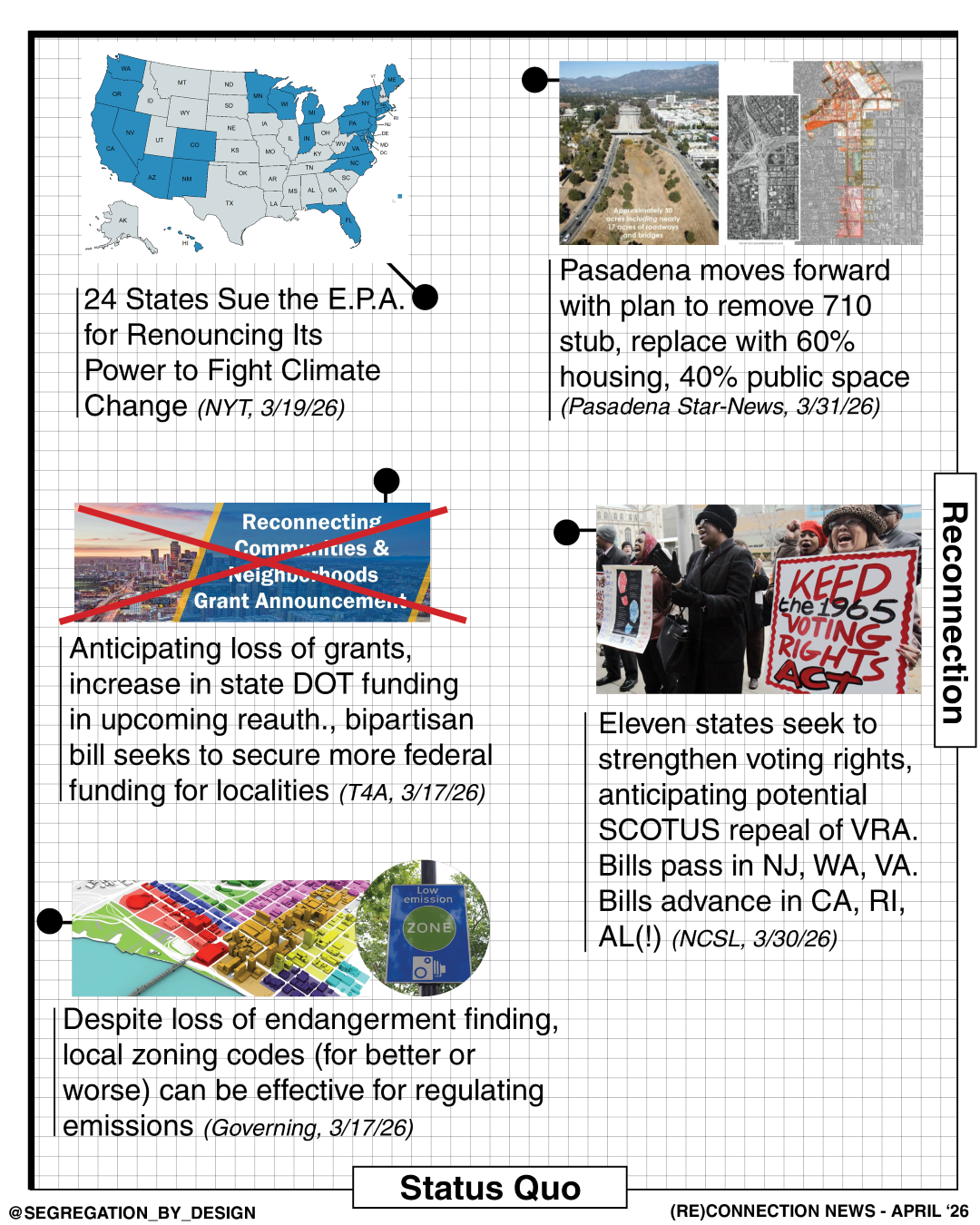
Back to the chart: Like last time, developments are arrayed along two axes: one axis which positions an item based on whether it represents progress towards reconnection, or the opposite; and another axis which (for better or worse) compares whether an item represents transformative change vs. something more ingrained in the status quo.
On the “Reconnecting” side are developments which are progress away from the legacy of “Segregation by Design.” These include projects which advance spatial justice, such as large-scale infrastructure redesigns for more equitable mobility/land-use/housing, legal victories for affected communities, reparative actions, etc. On the other hand, “Disconnection” is defined as items that are further retrenchment of exclusionary urban design and environmental racism.
Items on the “Transformative” half are developments that move away from present systems and procedures, potentially resulting in fundamental shifts to existing institutions and practices (again, for better or worse). This includes news involving novel legal arguments, funding mechanisms, infrastructure and design approaches, etc., or which indicate structural/long-term shifts to present institutions. On the other hand, “Status Quo” developments involve making use of established processes and represent less radical departures from existing systems (or, are potentially transformative projects which are still early in the development phase, and whose potential impact is difficult to determine).
Links
Transformative Disconnection
Five Takeaways From the Birthright Citizenship Argument (NYT, 4/1/26)
Deaths in ICE Custody Are Growing. ‘They Let Him Rot in There.’ (NYT, 3/31/26)
Trump Demands an All-but-Doomed Bill. The Value for Him May Be in the Fight. (NYT, 3/27/26)
Trump wants voting to be a ‘privilege.’ Here’s what that means. (WaPo, 3/25/26)
Trump Admin continues to promote “back to basics” approach for the upcoming reauthorization, which would mean more highway funding and fewer grant programs (Transportation Topics, 3/18/26)
The Bay Area Considers the Unthinkable: Life Without BART (NYT, 3/10/26)
Trump EPA Repeals Endangerment Finding (NYT, 2/12/26)
Supreme Court Sides With Conservative Congressman in Illinois Election Rules Challenge (NYT, 1/14/26)
Transformative Reconnection
Voting Rights Acts
Brief: State Voting Rights Acts (National Conference of State Legislatures, 4/1/26)
Election Legislation Trends to Watch in the Coming Months (National Conference of State Legislatures, 3/30/26)
Washington Enhances Voter Protections in Updates to State Voting Rights Act (3/27/26)
California lawmaker seeks to strengthen state Voting Rights Act (3/25/26)
New Jersey Assembly Passes New Jersey Voting Rights Act (3/24/26)
South Shore Line cuts ribbon on Monon Corridor (Indiana Public Media, 4/1/26)
Pedestrian Deaths Fell by Largest Percentage in 15 Years, but Remain Above Pre-Pandemic Levels (Planetizen, 3/31/26)
5 Takeaways From the ‘No Kings’ Rallies as the Midterms Heat Up (NYT, 3/29/26)
Everything You Need to Know About the 2 Line Crosslake Connection (The Urbanist, 3/28/26)
Chicago’s ICE playbook spreads as cities challenge Trump’s crackdown (Politico, 3/28/26)
How Camden, N.J., Cut Its Murder Rate to a 40-Year Low (NYT, 3/27/26)
Final Akron Innerbelt plan focuses on more houses, new roads (Signal Akron, 3/23/26)
Metro Board Unanimously Advances K Line North Light Rail Extension (Streetsblog LA, 3/26/26)
Mamdani DOT to lower speed limit to 15mph in school zones (Queens Daily Eagle, 3/17/26)
Traffic deaths declined an estimated 12% in 2025: National Safety Council (SmartCitiesDive, 2/26/26)
Status Quo Disconnection
Austin City Council urged to pause plan for parks over I-35 (KUT News, 3/25/26)
Federal Gateway funding remains delayed (The American Prospect, 3/24/26)
How DC’s mayor and council chair thwarted every effort to better the streetcar (GGWashington, 3/24/26)
LA Metro Plans to Spend Nearly $900M Expanding Freeways Next Year, a 40 Percent Increase (Streetsblog LA, 3/20/26)
Two state bills in Georgia aim to halt transit expansion in Atlanta (Saporta Report, 3/16/26)
Capping? Boulevarding? MnDOT chooses widening. (MinnPost, 3/13/26)
Bike and walking trails lose hundreds of millions under Trump (States Newsroom, 3/12/26)
Charlotte council wanted to pause the I-77 toll lane project. NCDOT beat them to it (Charlotte Observer, 3/3/26)
Status Quo Reconnection
Pasadena’s 710 stub project embarks on next phase in marathon toward healing, reconnection (Pasadena Star News, 3/31/26)
New Portal Bridge Opens BUT Gateway paused (The American Prospect, 3/24/26)
Judge orders Trump administration to temporarily unfreeze Chicago transit funding (Reuters, 3/24/26)
Pasadena panel sends vision for 710 stub to City Council (Pasadena Star-News, 3/19/26)
24 States Sue the E.P.A. for Renouncing Its Power to Fight Climate Change (NYT, 3/19/26)
State DOTs should spend their safety money on safety or hand it over to locals (Transportation for America, 3/17/26)
Even with federal deregulation, states can still enact climate policy through zoning codes (Governing 3/17/26)
MTA sues Trump administration for Second Avenue Subway funding (NYT, 3/17/26)